Strategy begins where the brief ends — with the question the brief never asks: what is this person actually carrying?
I connect business objectives to that weight. The KPIs follow from closing the gap between what the business needs and what the person needs. When both are clear, the path between them is the strategy.
Garry Kapoor
THE STRATEGY
I focus on the fundamental questions, let's explore the question with detailed examples.
01 - WHAT IS ACTUALLY
WORTH DOING?
VALUE
EXPECTATIONS
FEASIBILITY
COMPETITION
Before the workshop. Before the feature list. Before any of it — I write the weight sentence.
“What is this person carrying while they try to use what we are about to build? Not the persona. Not the use case. The specific weight of a specific human at a specific moment. That sentence becomes the acceptance criterion for everything that follows.”
Then I ask the direction question. Not what are we building — what are we pointing toward? A destination is fixed. You reach it or you don’t. A direction is alive. It adjusts. It deepens. Only a direction survives the first sprint under pressure. I name it before the leverage conversation begins, because a 600K vision built on the wrong direction compounds in the wrong place.
Then I ask the leverage question. The brief is the 100K — what we have been asked to build. The vision is the 600K — what this project controls if the direction holds all the way through. My job is to make the 600K visible before the first sprint begins.
Finally — the arc question. Most products are built for Buildings 2 and 3. Acquisition and onboarding. The metrics are there, the sprints are resourced, the floors are lit. Buildings 4 and 5 — the loyal user, the person who leaves and might return, the one who tells someone else — are dark. Strategy means deciding which buildings we are committing to in this sprint and naming honestly which ones we are leaving without an usher.
METHOD - WORKHOP
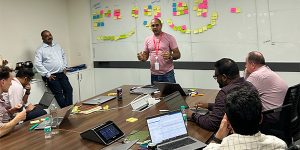
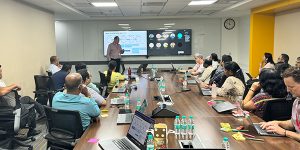
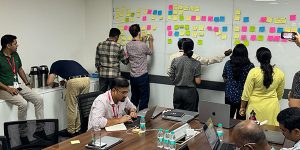
15–20 participants across marketing, product, engineering, sales, and support.
Elevated Pitch: value proposition, customer segment, channel partners, headline feature
Business Model Canvas
Gap and Competitive Analysis
Strategy Proposal: direction named, leverage mapped, arc committed to
02 - WHAT SOLUTION ARE WE
CREATING?
FEATURE
CONTENT
PLATFORM
As a facilitator, my role is to ensure everyone is aligned before any work begins. It’s crucial that all stakeholders share a clear understanding of what is being built and why. This includes agreeing on the feature set and necessary functionality.
Even if it’s not explicitly requested, ensuring consensus among all involved falls under my responsibility because I am ultimately accountable for the end result.
METHOD - WORKHOP
Identifying the scope of the project is discussed as a part of the workshop.
This discussion includes the following activities in the workshop:-
Program Scope – Step > Stretch > Leap
Product in Box (Concept)
Key Value Drivers, Realization, Business Model
03 - WHAT USER VALUE WILL
IT PROVIDES?
ROLE
EXPECTATIONS
PAIN-POINTS
DESIRES
VALUE
I gain empathy with target users by understanding their responsibilities, specific needs, challenges, problems, and desires. By mapping these user pain points with the business strategy and vision, I enable the creation of valuable business outcomes.
This approach helps me identify a specific audience and define a meaningful user experience that addresses critical needs and motivates usage effectively.
METHOD - VOCs/OVOCs, INTERVIEWs, SURVEYs
I identify the user’s role, responsibilities, daily activities, goals, critical experience outcomes, teams they collaborate with, and key pain points. This comprehensive understanding allows me to create a journey map that reflects their daily touchpoints, emotions, and expectations. I also capture environmental factors to contextualize these pain points effectively.
MAP THE USER PAINs
WITH BUSINESS GAINs
REVENUE
MARKET
OPER. EFFICIENCY
USABLE
INTIUTIVE
Team develops targeted solutions that address the root causes of user pain points, whether through product improvements, policy changes, or service enhancements. This involves tailoring products or services to meet the specific needs of different user segments. Additionally, The team identifies opportunities where technology can automate processes, offer self-service options, or enhance overall efficiency.
METHOD - WORKSHOP
By integrating a Business Model with a Product Management Canvas, incorporating inputs such as research, user data analysis, user journey mapping, prioritized pain points, process optimization, technology feasibility, and improved customer service, our team transforms user challenges into opportunities for enhancement. This approach aims to boost customer satisfaction and loyalty by creating a seamless and delightful experience. Ultimately, our goal is to achieve positive business outcomes through these efforts.